
Education · 24 June 2026
Phonics through personalised stories: learning without the worksheet feel
Discover how to transform phonics practice from a kitchen-table battle into a magical bedtime adventure. By combining decodable reading patterns with personalised stories, you can help your child master early reading skills without a single worksheet in sight.
Turn reading practice into their story
Make a personalised book starring your child — a gentle way to build confidence with words they'll actually want to read.
It is 4:30 on a rainy Tuesday afternoon. You are sitting at the kitchen table, surrounded by half-eaten snacks, a cold cup of tea, and a crumpled school reading folder. Your child is slumped in their chair, suddenly fascinated by a speck of dust on the floor, doing everything in their power to avoid looking at the page in front of them.
"The..." they begin, sighing heavily. "The... c-a-t..."
They stop. They look at you with pleading eyes. You feel a familiar pang of guilt and frustration. You know phonics is the foundation of reading. You know they need to practice. But right now, this book about a cat sitting on a mat feels less like a bonding moment and more like a battle of wills.
If this sounds familiar, you are entirely in good company. For many families, early reading practice can quickly devolve into 'worksheet fatigue'. But what if we could strip away the clinical, test-like feel of early reading and replace it with genuine wonder?
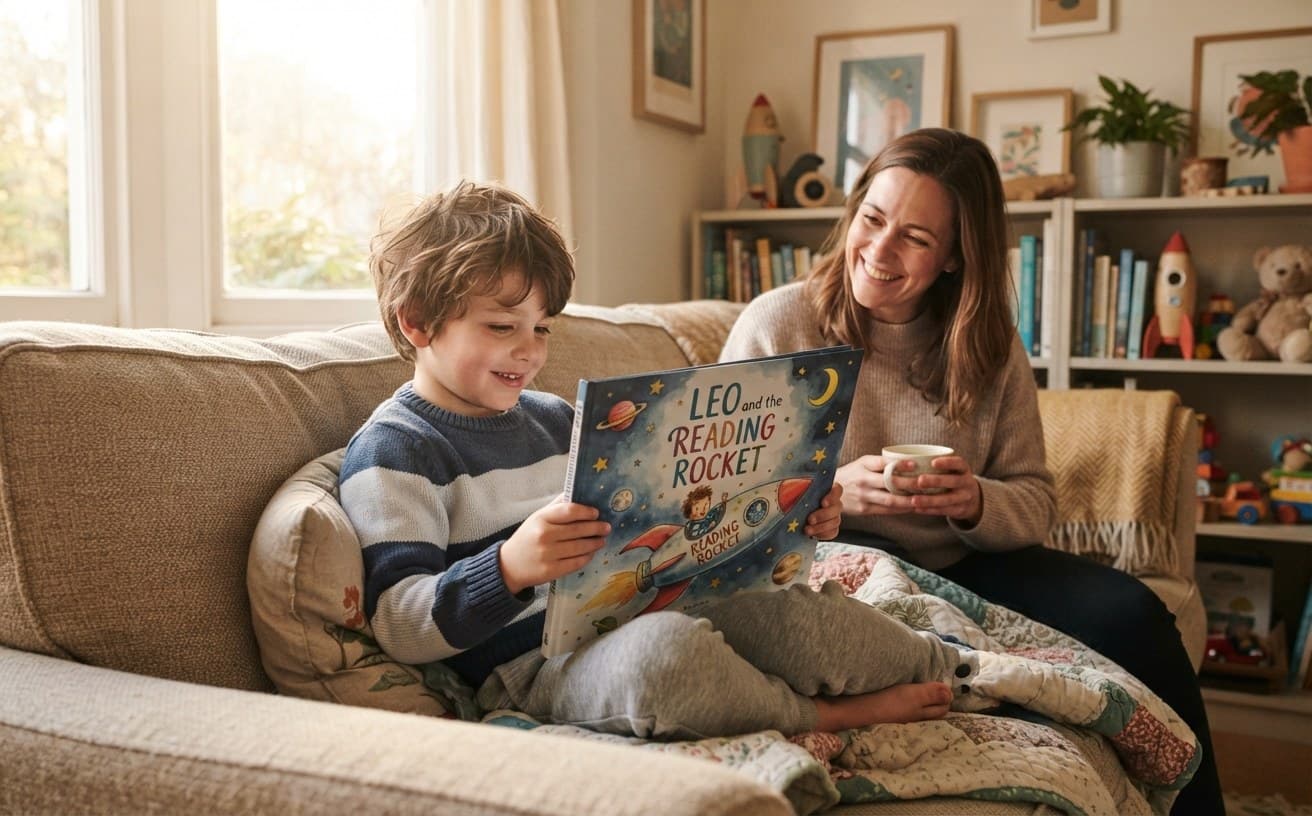
By using a personalised phonics story for kids, we can weave essential decodable patterns into tales featuring your child's favourite things, turning reading from a chore into a highlight of their day.
---
The Kitchen Table Battle: Why Traditional Phonics Can Feel Hard
Phonics is the brilliant, proven method of teaching children to read by linking sounds (phonemes) to the letters that represent them (graphemes). It is the backbone of the primary curriculum in the UK, and for good reason: it works.
However, the books designed to teach these early stages—often called decodable readers—can sometimes feel a little dry. In an effort to strictly limit the vocabulary to words a child can decode, these stories can lose their spark. When a story lacks plot, humour, or relatable characters, children quickly realise they are being 'taught' rather than entertained.
This is where resistance builds. When reading feels like a test, children who struggle or who are simply tired after a long school day shut down. If you are navigating this hurdle, you might find our guide on stories for reluctant readers helpful for understanding the emotional blocks around early literacy.
We need a way to keep the strict educational structure of phonics but wrap it in a warm blanket of imagination.
---
What is a Phonics Story for Kids?
A phonics story for kids is a narrative specifically written to highlight and repeat specific letter-sound correspondences. Unlike standard picture books, which might use complex vocabulary, a phonics-focused story carefully controls the words used so that early readers can successfully sound them out.
For example, if your child is currently learning the 'sh' sound at school, a targeted phonics story might focus on a character who goes to a shop to buy a shell and a ship.
When children successfully decode these words on their own, it builds a massive wave of confidence. They realise that letters aren't random symbols; they are a secret code they have the power to crack. The trick is making sure the code is hidden inside a story they actually care about.
---
The Magic Ingredient: Personalisation
Why does personalisation change the game so completely? It all comes down to emotional investment.
When a child opens a book and sees their own name, their pet dog, or their favourite local park woven into the text, their brain lights up. They are no longer reading about a generic character in an unfamiliar world. They are reading about *themselves*.
Personalisation provides: * Instant Engagement: The curiosity of seeing what 'their' character will do next overcomes the initial hesitation to read. * Contextual Clues: Because the setting and characters are familiar, children can use their real-world knowledge to help make sense of the text, reducing cognitive overload. * Emotional Safety: Reading can feel risky for a child who is afraid of making mistakes. Sharing a story about themselves, read in the safety of a parent's lap, lowers their anxiety and makes them more willing to try.
Using a bedtime story generator to craft these adventures allows you to tailor the narrative to your child's exact interests, whether they are obsessed with diggers, space travel, or talking unicorns.
---
How Decodable Patterns Support Early Reading (Without the Boredom)
To make a personalised phonics story work effectively, it needs to strike a balance between decodable words and rich, engaging storytelling. In education, we look at this through two lenses:
1. Decodable Words (The Child's Part) These are words made up of the letter sounds your child has already learnt. If they are in Reception or Year 1, this might start with simple three-letter words (consonant-vowel-consonant, or CVC words) like *dog*, *run*, and *sit*. As they progress, it expands to include digraphs (two letters making one sound) like *ch*, *th*, and *ee*.
2. Tricky Words / Common Exception Words These are words that cannot be easily decoded using phonics rules at their current level (such as *the*, *was*, *said*, and *to*). A good phonics story includes just enough of these to keep the story flowing naturally, without overwhelming the reader.
3. The 'Read-Together' Bridge In a personalised story, you don't have to make every single word decodable. You can use a 'shared reading' approach. You read the rich, descriptive parts of the adventure, and your child proudly takes over whenever a target phonics word appears.
For example: > *Parent:* "The brave knight Leo climbed up the high, rocky hill. When he reached the top, he looked into the dark cave and saw a..." > *Child (decoding):* "...b-i-g... r-e-d... d-o-g!"
This collaborative approach keeps the plot exciting and fast-paced, while still giving your child high-quality, targeted reading practice.
---
Moving Away from the Worksheet Feel
How do we ensure these reading sessions feel like a treat rather than homework? Here are a few practical tips to keep the atmosphere light, warm, and supportive:
* Let go of perfection: If your child gets stuck on a word, don't let them struggle to the point of tears. Give them the sound, or read the word for them, and move on. The goal is enjoyment and flow, not a perfect test score. * Bring the story to life: Use silly voices for the characters. If the story features their favourite teddy bear, have the teddy bear 'sit' with you and listen to the story. * Celebrate the effort, not just the accuracy: Praise them for trying to sound out a difficult word, even if they didn't get it quite right. "I loved how you tried to sound out that middle letter, that was fantastic trying!" * Keep sessions short: Ten minutes of joyful, engaged reading is infinitely more valuable than thirty minutes of tearful, forced study.
---
How TurtleTime Can Help
At TurtleTime, we believe that bedtime is a sacred space for connection, laughter, and quiet wind-down. It shouldn't be a battleground for schoolwork.
Our platform allows you to create beautifully tailored stories that combine the magic of personalisation with the gentle support of early reading patterns. You can input your child's name, their current interests, and even specify the sounds they are working on at school.
The result is a bespoke phonics story for kids that feels like a pure adventure to them, whilst secretly doing all the heavy lifting of a structured school reading session. It is learning, wrapped up in a cuddle.
Instead of fighting over crumpled school books, you can sit together, open a story written just for them, and watch their confidence grow page by page.
---
Make tonight's story
Ready to transform your bedtime reading routine? Create a unique, personalised adventure that targets the exact sounds your child is learning at school, without any of the worksheet stress.
Turn reading practice into their story
Make a personalised book starring your child — a gentle way to build confidence with words they'll actually want to read.