
Education · 27 July 2026
Counting Stories for Preschoolers: Building Maths Confidence
Discover how custom counting stories can transform early maths from a chore into a magical adventure. Learn how placing your child at the heart of the story builds lasting confidence.
Turn reading practice into their story
Make a personalised book starring your child — a gentle way to build confidence with words they'll actually want to read.
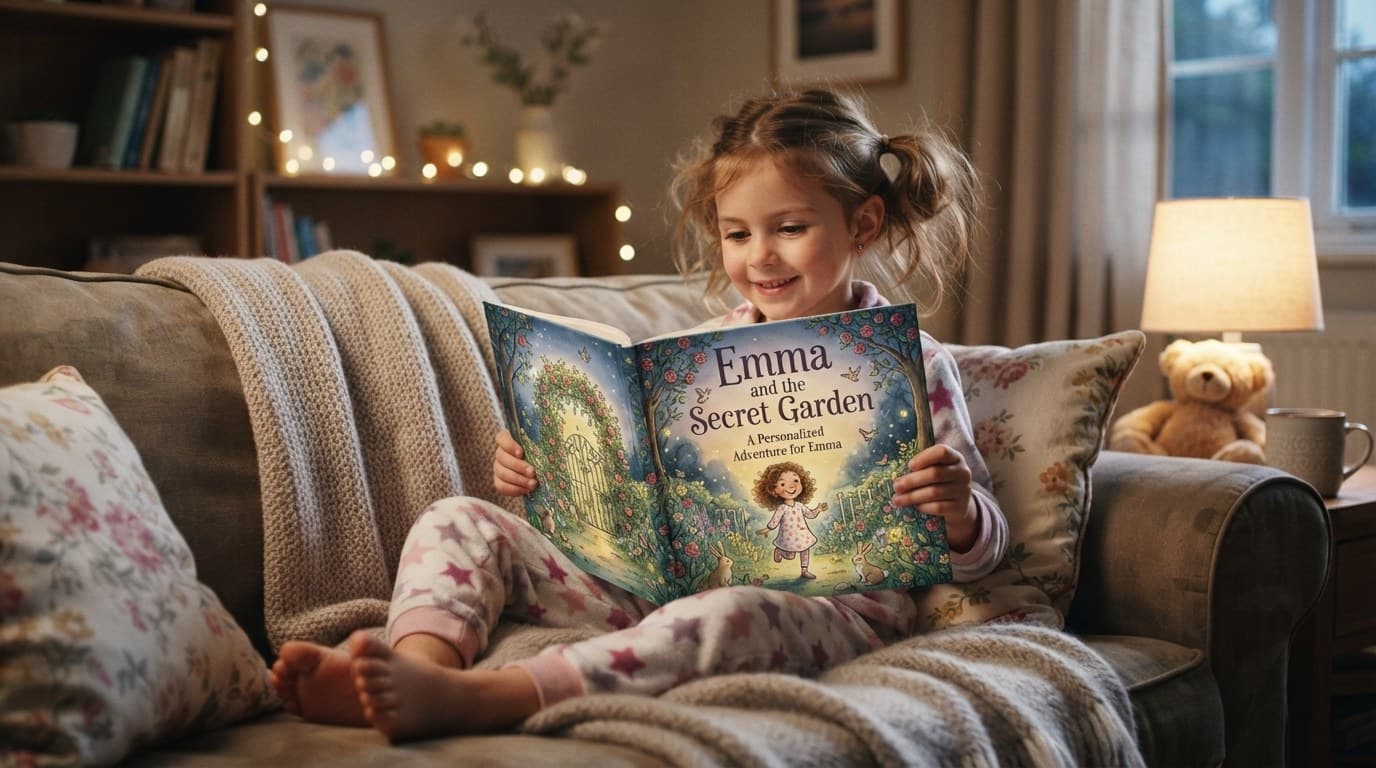
For many parents and grandparents, the phrase 'early years maths' might conjure up images of flashcards, repetitive tracing worksheets, and perhaps a little bit of resistance from a tired preschooler. But introducing numbers to a three- or four-year-old doesn't have to feel like a classroom chore. In fact, it shouldn't.
At this tender age, children learn best through play, imagination, and connection. This is where the magic of storytelling comes in. By blending early numeracy with narrative adventures, we can demystify numbers and build a foundation of maths confidence that lasts a lifetime. When we take this a step further with customisation, the results are truly wonderful.
Let's explore why counting stories are so effective for preschoolers, how customisation supercharges their learning, and how you can bring these adventures into your daily routine.
---
The Magic of Narrative Maths
To a young child, abstract numbers like '3', '7', or '10' are just strange squiggles. They don't have an inherent meaning. If you ask a preschooler to memorise these symbols, they might manage it by rote, but they won't necessarily understand what they represent.
Stories solve this problem by providing context.
When a number is attached to a character, an obstacle, or a reward, it suddenly makes sense. Counting three apples to feed a hungry baby dragon is infinitely more interesting than counting three dots on a page. The child isn't just reciting numbers; they are solving a problem to help a friend. This narrative transport shifts maths from an abstract task into an active, emotional experience.
Why Narrative Maths Works: * It reduces anxiety: There is no 'test' pressure in a storybook. If a child counts incorrectly, the story gently guides them back without any feelings of failure. * It builds vocabulary: Counting stories naturally introduce spatial language (above, below, next to) and comparative terms (more, less, bigger, smaller). * It encourages active participation: Children love to point, touch, and count aloud to help the characters progress through the tale.
---
Why Customisation Changes Everything
While traditional counting books are wonderful, there is a unique magic that happens when a story is customised.
Psychologists often talk about the 'self-referencing effect'—the phenomenon where we remember information much better if it relates to us personally. For a preschooler, seeing themselves in a story isn't just exciting; it completely changes how they process the information.
When searching for counting stories for preschoolers custom-tailored to their specific world, parents often find that engagement levels skyrocket. If the hero of the book looks like them, has their name, and is counting their favourite things—perhaps their own teddy bears, or the specific number of steps in their grandmother's garden—the maths becomes personally relevant.
They aren't just watching someone else count; *they* are the ones doing the counting. This subtle shift builds a deep sense of capability. 'If the hero of the story (who is me!) can count all the way to ten to find the hidden treasure, then I can do it too.'
This is why we love Personalised children's books. They bridge the gap between fantasy and reality, making the educational takeaways incredibly sticky.
---
Practical Ways to Tell Counting Stories at Home
You don't need a library of specialised textbooks to start using narrative maths. You can easily weave these concepts into your everyday conversations and storytelling.
1. The 'Count-Along' Walk Turn a simple walk to the local park into an epic quest. You might say: 'Today, we are the Brave Knights of the Green Park. To cross the grassy bridge, we must find and count five smooth grey stones.' This simple framing turns a mundane walk into a counting adventure where your child is the main character.
2. The Missing Toy Mystery Preschoolers love solving mysteries. Gather a small group of their favourite toys—say, four stuffed animals. Tell a quick story: 'Oh no! The Toy Inspector says there should be four friends at the tea party, but I only see three! Who is missing?' This encourages basic subtraction and addition concepts in a completely playful, low-stakes environment.
3. Visual and Physical Props When reading any story, use physical objects to represent the items in the book. If the character in the story finds three keys, hand your child three real keys (or building blocks) to hold. Linking the visual illustration to a physical object in their hand builds strong neural pathways for spatial awareness and quantity.
---
Elevating the Experience with Modern Technology
While telling stories off-the-cuff is a brilliant daily habit, there is something incredibly special about a physical book that children can hold, revisit, and treasure.
This is where modern technology can support busy parents and grandparents. Today, you don't have to settle for generic stories where only a name is swapped out. With advanced Photo storybooks, you can now upload a simple photo of your child and see them transformed into a beautifully illustrated hero of their own educational adventure.
At TurtleTime, we craft these experiences with care. We know that every child's learning journey is unique. Our platform allows you to create customised stories where your child's real likeness is woven into the illustrations. You can choose themes that excite them—whether that's exploring a counting forest, diving deep under the sea to count colourful fish, or blasting into space to count shiny stars.
To make it even more accessible for different learning styles, these stories come with professional read-aloud narration, making them perfect for quiet afternoons or independent reading time. And for those who love the feel of paper, you can have them printed as beautiful, keepsake hardcovers.
---
Making Maths a Bedtime Habit
One common concern for parents is finding the time to fit educational activities into an already packed day. Between school runs, meal prep, and bath time, sitting down for a structured maths lesson can feel impossible.
The secret is to integrate it into routines you are already doing. Bedtime reading is the perfect opportunity.
By using a smart Bedtime story generator, you can create gentle, calming tales that naturally weave in soft counting elements. Instead of high-energy maths games, bedtime counting stories can focus on winding down: counting the slowly appearing stars in the night sky, counting the deep, slow breaths of a sleepy woodland creature, or counting the steps up to a cosy treehouse bed.
This associates numbers with feelings of safety, warmth, and relaxation, completely removing any subconscious 'maths anxiety' before it ever has a chance to take root.
---
The Gift of Confidence
Ultimately, early years maths isn't about getting every answer right on the first try. It is about curiosity, resilience, and confidence.
When we teach children that numbers are just part of the stories we tell and the adventures we go on, we give them a priceless gift. They enter primary school seeing themselves as 'people who are good at maths.' They don't fear the numbers; they welcome them as familiar characters from their favourite bedtime tales.
Whether you are telling stories from your own imagination, counting steps on the way to the shops, or creating a bespoke illustrated book that they will keep forever, you are building a foundation of confidence that will support them for years to come.
---
Make tonight's story
Ready to turn your child into the hero of their own learning adventure? With TurtleTime, you can create a personalised, illustrated storybook featuring your child's real likeness in just a few clicks.
It is completely free to try, and you don't need to enter a credit card to see your child's face beautifully illustrated on the page. Create a story tonight and watch their eyes light up as they count their way through a world designed just for them.
Make tonight's story
Upload a photo, pick a theme, and read a brand-new illustrated adventure aloud in about a minute — create your free story.
Turn reading practice into their story
Make a personalised book starring your child — a gentle way to build confidence with words they'll actually want to read.