
Guides · 5 July 2026
Photo storybooks vs name-only personalisation: what's the difference?
Is a personalised book really personal if it only changes the name? Discover the difference between basic template customisation and modern photo storybooks that capture your child's true likeness.
Ready to make your first book?
Upload a photo, choose a theme, and preview a complete illustrated story in about a minute — no card needed.
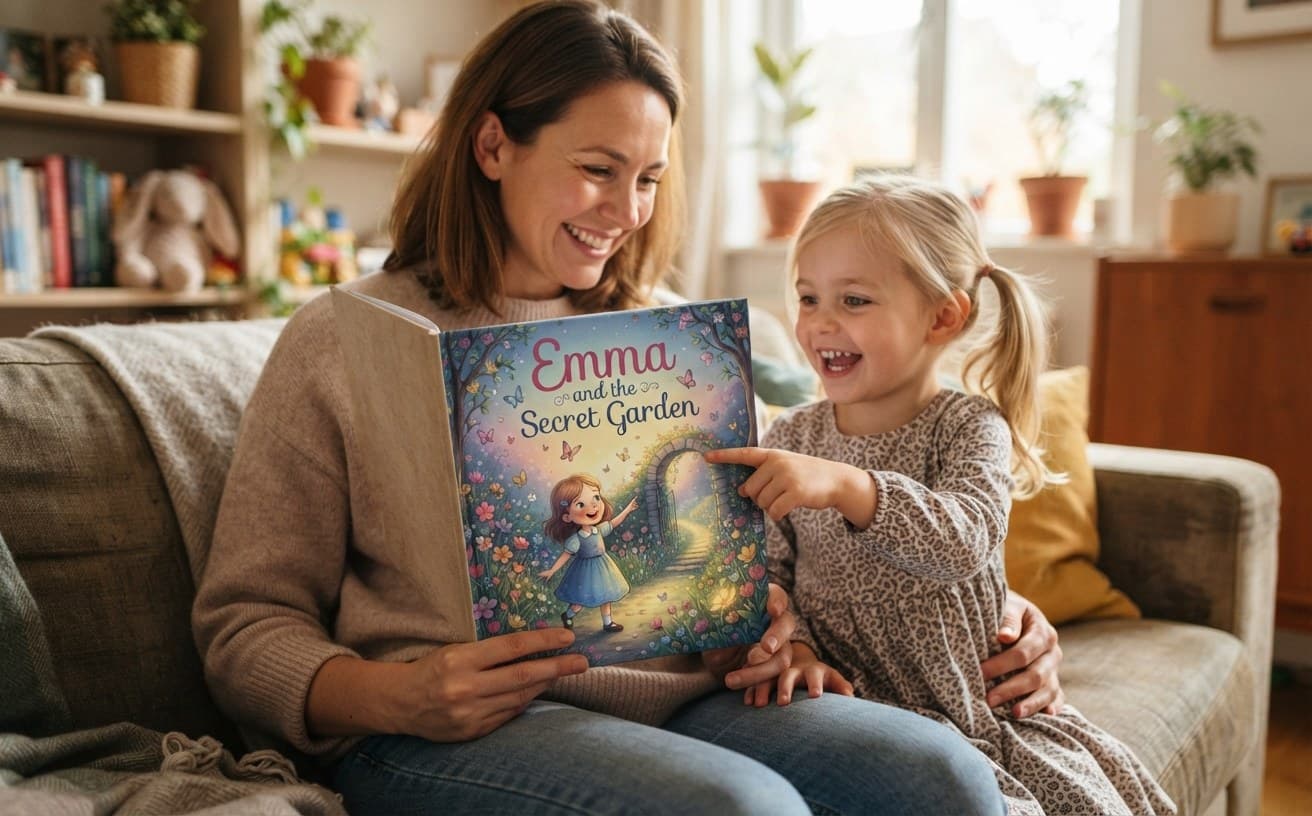
Picture the scene: it’s 7:15 PM. You’ve successfully navigated bath time, the pyjamas are on (after the usual negotiation), and your little one is tucked under the duvet. It’s time for the best part of the day—the bedtime story.
As parents, we’re always looking for ways to make these quiet moments more magical, to spark a lifelong love of reading. That’s why personalised children's books have taken the parenting world by storm over the last decade. There is nothing quite like the look on a child’s face when they realise the hero of the story shares their name.
But as technology has evolved, a new question has emerged for parents browsing for the perfect keepsake: what is the difference between a traditional, name-only personalised book and a modern, AI-powered photo storybook?
Is it worth making the leap from swapping a name in a template to generating a true illustrated likeness? Let’s dive into the details, look at the science of child development, and compare the two side-by-side.
---
What is name-only personalisation?
We’ve all seen these books, and many of us own them. They are the pioneers of the custom book world.
With name-only personalisation, the publisher uses a pre-written story template. When you order, you type in your child’s name (e.g., "Leo" or "Amara"), select a generic avatar that roughly matches their hair colour and skin tone, and the printing software inserts those details into the pre-existing layout.
How it works: * The Text: The story is static. Every child named Leo, Amara, or Oliver gets the exact same adventure, word-for-word. * The Illustrations: The artwork is pre-drawn by an illustrator. You might get to choose from a few options (e.g., "boy with brown curly hair" or "girl with blonde straight hair"), but the character is a generic representation. * The Delivery: The system swaps the text variables and prints the book.
While these books are lovely, they can sometimes feel a bit like a game of mad-libs. The connection is intellectual—the child hears their name—but it isn't always visual or deeply personal.
---
What is a photo storybook?
Now, let’s look at the next generation of bedtime magic: the photo storybooks.
Instead of relying on a database of pre-drawn, generic avatars, a photo storybook uses advanced, secure AI technology to analyse a photograph of your child. It then generates custom, high-quality illustrations that capture their actual likeness—their unique smile, the shape of their eyes, their favourite messy curls, or the cheeky dimple in their cheek.
At TurtleTime, we combine this visual magic with our bedtime story generator to create a completely bespoke book where your child is truly the star, both in name and in stunning, recognisable illustration.
How it works: * The Photo Upload: You upload a clear photo of your child. * The Likeness Generation: Smart AI technology translates that photo into a beautiful illustration style (such as watercolour, 3D claymation, or classic fairy-tale sketch), preserving their distinct facial features. * The Bespoke Story: The child is woven directly into the narrative, seeing themselves climb mountains, explore space, or talk to friendly woodland creatures, looking exactly like *them*.
---
Likeness in illustrations vs swapping a name: the key differences
To help you decide which option is right for your family, let’s break down the practical and emotional differences between these two approaches.
| Feature | Name-Only Personalisation | Photo Storybook (TurtleTime) | | :--- | :--- | :--- | | Visual Recognition | Low. The child looks like a generic cartoon avatar. | High. The child instantly recognises their own face and features. | | Story Flexibility | None. The story is a fixed template. | High. Stories can be tailored to your child's specific interests. | | Emotional Impact | "Oh look, that character has my name!" | "Mummy, look! That is actually *me* in the spaceship!" | | Inclusivity | Limited. Avatars often fail to capture diverse features, hair textures, or medical wear (like glasses or hearing aids). | Unlimited. The AI captures the child exactly as they are, naturally and beautifully. | | Keepsake Value | Medium. A nice novelty gift. | Extremely High. A time capsule of what your child looked like at this exact age. |
---
Why seeing their true likeness matters to children
It might seem like a small detail—surely a child has enough imagination to pretend the generic cartoon character is them?
While children do have wonderful imaginations, child psychology tells us that seeing an accurate visual representation of themselves has a profound impact on their cognitive development and emotional connection to reading.
1. Mirroring and self-esteem When a child sees a character who looks exactly like them—sharing their unique skin tone, their wild hair, or their glasses—it sends a powerful message: *people like me belong in stories. I am the hero.* This visual mirroring boosts self-esteem and fosters a strong sense of identity, particularly for children who don't often see themselves represented in mainstream children's literature.
2. Deeper reading comprehension For younger readers (toddlers to early primary school), abstract thinking is still developing. When they read a name-only book, there is a cognitive gap between hearing their name and looking at an illustration of a child who doesn't quite look like them. A photo storybook closes this gap. Because they instantly recognise themselves, their working memory can focus entirely on the plot, vocabulary, and moral of the story, leading to better comprehension.
3. Overcoming reading reluctance If you have a reluctant reader, the battle to open a book can be exhausting. Traditional books can feel like a chore. However, when a child is handed a book and sees *their own face* on the cover, riding a dinosaur or exploring a magical castle, curiosity wins every time. It turns reading from a passive task into an active, exciting adventure.
---
The TurtleTime difference: blending technology with warmth
At TurtleTime, we didn't want to create just another generic custom book. We wanted to capture the genuine, fleeting magic of childhood. Children grow up so fast; their features change from month to month.
A TurtleTime photo storybook acts as a beautiful time capsule. By using our secure, parent-friendly platform, you can create a gorgeous, professionally bound book that preserves your child’s sweet face at age three, five, or seven forever.
Combined with our intuitive bedtime story generator, you can craft stories that address their real-life experiences—like starting school, learning to share, or overcoming a fear of the dark—making the book both a comforting tool and a treasured keepsake.
---
Which should you choose?
If you are looking for a quick, budget-friendly novelty gift for a classmate's birthday, a name-only template book is a perfectly fine option.
But if you want to create a deeply emotional, magical bedtime routine that your child will ask for night after night—and a keepsake that you will tuck away in a memory box long after they’ve grown up—a photo storybook is in a league of its own. It is the difference between reading a story *about* someone else, and truly stepping *into* the magic yourself.
Ready to see your child bring their very own adventure to life?
Make tonight's story
Transform your child's favourite photo into a stunning, personalised adventure today. Head over to our storybook creator and design a bedtime memory that will last a lifetime.
Ready to make your first book?
Upload a photo, choose a theme, and preview a complete illustrated story in about a minute — no card needed.