
Guides · 2 November 2026
Photo to Storybook: How AI Turns Your Child into the Hero
Ever wondered what happens behind the scenes after uploading a photograph for a custom picture book? Here is a clear, step-by-step look at how modern facial mapping, artwork generation, and printing work together.
Ready to make your first book?
Upload a photo, choose a theme, and preview a complete illustrated story in about a minute — no card needed.
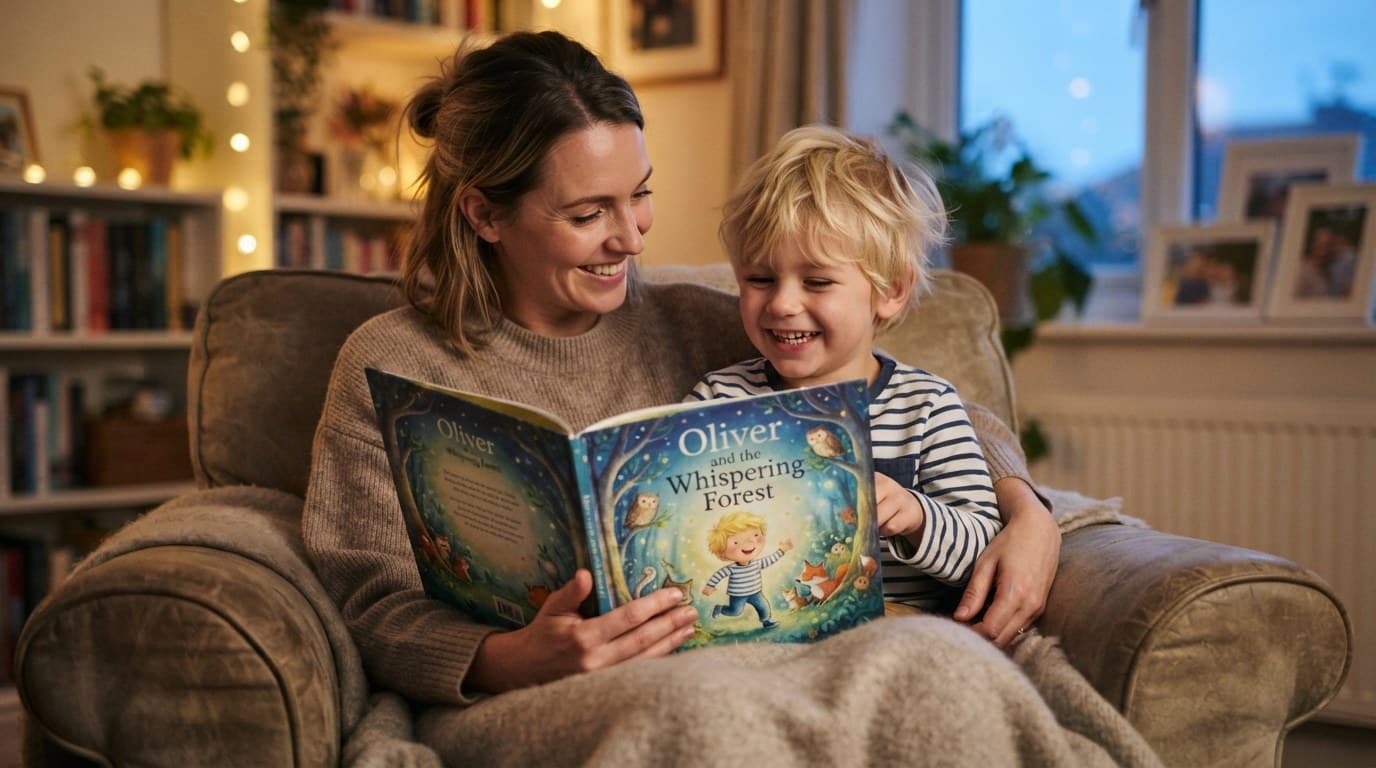
There is a distinct kind of magic that happens when a child sees themselves inside the pages of a book. For decades, personalised children's books accomplished this by swapping names: replacing the main character's name with your child's, or allowing you to choose hair colour and skin tone from a preset menu.
Today, modern artificial intelligence has shifted that experience entirely. Now, a single snap taken on your phone can transform your child into the painted protagonist of a grand adventure—complete with their real smile, haircut, and expressive eyes.
If you have ever considered creating one of these books, you might wonder: what actually happens after you click 'upload'? How does a flat digital photo become a fully illustrated, multi-page storybook without looking like a crude cut-and-paste job?
Here is a complete, step-by-step breakdown of how photo-to-storybook technology works behind the scenes, from image analysis to the printed page.
---
Step 1: The Input — Analysing the Reference Photo
The journey begins with a photograph. When you upload a picture of your child, the software isn't just looking at the photo as a static image to paste onto a template. Instead, it reads the photograph as reference data.
What the computer sees When an image enters the processing pipeline, computer vision algorithms scan the photo to identify key facial landmarks. These include:
* Facial structure: The shape of the chin, cheeks, jawline, and forehead. * Feature placement: The exact spacing between the eyes, nose, and mouth. * Distinctive traits: Hair texture, hair colour, eye shape, and characteristic expressions like a crooked grin or dimples.
Why photo quality matters While advanced models are very forgiving, starting with a clear, well-lit photo yields the best results. Soft daylight and a direct face-on angle allow the system to map features accurately without having to guess what lies in heavy shadow.
---
Step 2: Creating a Character Embedding (The Digital Blueprint)
Once the algorithms have scanned the photograph, the system creates what machine learning engineers call a character embedding or a conceptual model.
Think of this step like commissioning a portrait painter. If an artist were painting your child across twelve different scenes, they wouldn't cut up your photograph with scissors; they would study your child’s likeness, memorise their features, and then paint them from scratch in various poses.
Generative AI works similarly:
1. Extraction: It separates your child’s facial characteristics from the background, lighting, and clothing in your original upload. 2. Translation: It translates those facial traits into mathematical parameters within the AI art model. 3. Consistency Training: It establishes a temporary 'anchor' so the system remembers precisely who the character is across every frame of the story.
This crucial step ensures your child looks recognisably like themselves on page one, page five, and page twelve—even as they change outfits, turn sideways, or fly on the back of a friendly dragon.
---
Step 3: Generating the Story Arc
While the visual engine builds the character blueprint, the narrative engine goes to work. A great picture book requires more than pretty pictures; it needs a narrative with pacing, emotional beats, and age-appropriate language.
Many modern platforms pair character generation with a dedicated bedtime story generator. By combining the child's name, age, and interests (such as space exploration, dinosaurs, or deep-sea diving), large language models construct a custom narrative script divided into individual scene prompts.
Each scene prompt includes two components: * The written story text: Warm, rhythmic prose designed for bedtime reading. * The visual prompt: A detailed instruction for the illustration engine describing the background setting, action, lighting, and emotional mood.
---
Step 4: Illustration Rendering — Blending Likeness into Art
This is where the real visual transformation happens. The art engine takes the visual scene prompt (e.g., *"The child sits atop a glowing moonlit cloud, looking down at a sleeping city"*) and merges it with the child's established character embedding.
Unlike old digital photo editing, modern AI rendering synthesises the entire scene at once. The system calculates how the ambient light of the fictional world should reflect off the child's skin and hair. If the scene is set underwater, the hair floats naturally; if it is set in a sunny meadow, warm golden hour light illuminates their profile.
Platforms specialising in custom photo storybooks, such as TurtleTime, apply consistent artistic styles—such as soft watercolour, classic gouache, or vibrant digital painting—to ensure every page feels cohesive, as though it were crafted by a single master illustrator.
Maintaining Character Consistency One of the biggest historical hurdles in AI art was getting the same character to look consistent from page to page. Early generative tools would render a completely different face every time you generated an image. Today, specialised techniques like *ControlNet* and *LoRA (Low-Rank Adaptation)* lock down facial structure while allowing the body pose, expression, and environment to change dynamically.
---
Step 5: Audio Synthesis (Read-Aloud Narration)
For modern digital storybooks, the experience extends beyond reading print off a page. Once the text and illustrations are merged, text-to-speech AI models can generate synchronized voice narration.
Advanced audio models interpret the emotional tone of the story. Rather than sounding like a robotic GPS navigation voice, modern narration uses realistic pacing, natural pauses, and gentle cadence designed to help young children wind down at bedtime.
---
Step 6: Print Production & Quality Assurance
If you opt for a physical hardcover copy, the digital files undergo a technical preparation stage before heading to print:
* RGB to CMYK Conversion: Screen pixels display in RGB (Red, Green, Blue), whereas physical printing presses use CMYK (Cyan, Magenta, Yellow, Key Black) inks. Color profiles are carefully calibrated so the printed artwork matches the warmth and brightness of the digital preview. * Bleed and Margin Layout: Images are formatted with high-resolution print bleeds to ensure illustrations stretch edge-to-edge across thick, durable pages without awkward white borders. * Hardcover Binding: Pages are bound into sturdy covers designed to withstand repeated readings by enthusiastic little hands.
Services like TurtleTime handle this end-to-end pipeline automatically—taking your initial photo, building the story arc, generating matching audio narration, and delivering a bookstore-quality hardcover straight to your door.
---
What About Privacy and Safety?
As a parent or grandparent, it is completely natural to wonder about security when uploading images of your child. Reputable AI storybook platforms follow strict data protection protocols:
* Private Processing: Photos are processed in secure cloud environments and are never exposed to public databases. * No Public Training: Your child's photos are used strictly to generate your specific book order and are not fed into public AI training models. * Data Retention Policies: Original photos and temporary character embeddings are stored securely only for as long as needed to fulfill your book and preview, after which they can be permanently deleted.
Always check a platform's privacy policy to ensure your images remain entirely private to your family.
---
Summary: From Single Photo to Family Heirloom
What feels like magic on the surface is actually a carefully coordinated dance of computer vision, generative artwork, and traditional bookmaking. By turning a photograph into a digital character blueprint rather than a crude cutout, modern AI creates stories where your child genuinely belongs in the artwork.
The result is more than just a personalized novelty; it is an engaging keepsake that builds literacy, encourages a love for reading, and lets children see themselves as the brave, curious heroes of their own imagination.
---
Make tonight's story
Ready to see your child transform into the hero of their very own picture book? Try TurtleTime today and create a custom preview in moments. Upload a photo, pick an adventure, and watch their story come to life—completely free to try, with no credit card required.
Make tonight's story
Upload a photo, pick a theme, and read a brand-new illustrated adventure aloud in about a minute — create your free story.
Ready to make your first book?
Upload a photo, choose a theme, and preview a complete illustrated story in about a minute — no card needed.